

Words: Rohinton Mehta
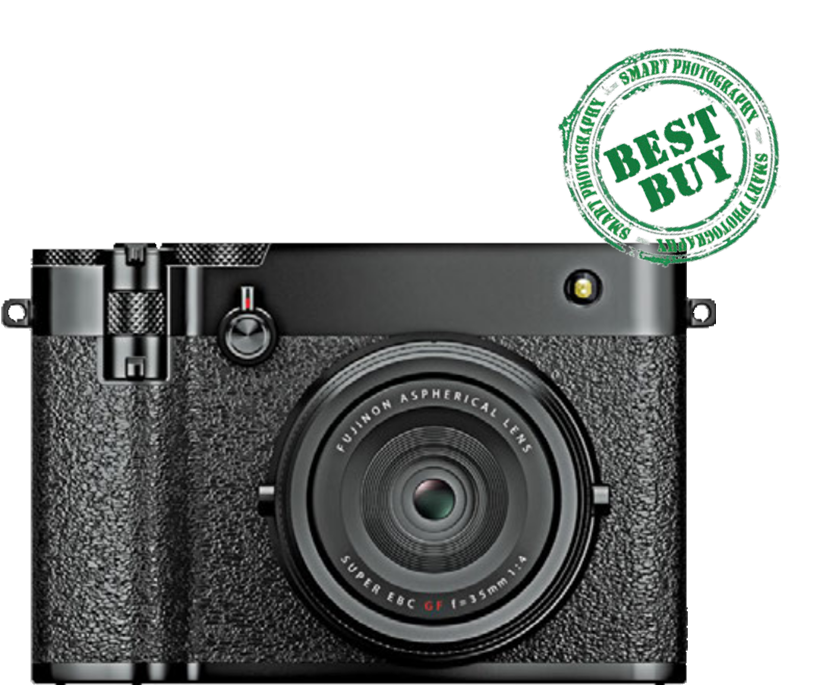
The Fujifilm GFX 100RF was introduced in India on 19th May 2025. Fujifilm describes the camera as ‘medium format’. I prefer to call it ‘cropped medium format’. ‘Medium format’ is generally 60x60mm or 60x45mm. The imaging sensor size of the GFX 100RF is 43.8×32.9mm. The camera is aimed primarily at photographers who want great detail in their landscapes, environmental portraits, and studio work, but can be judiciously used for indoor sports, photojournalism and by those who have reasons to crop their frames for a better composition. Let’s see how the GFX 100RF performs.
Design & Build Quality
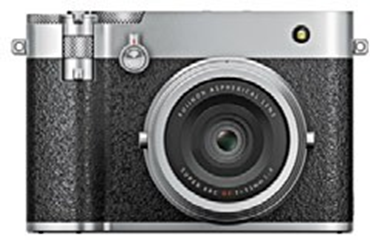
Magnesium alloy chassis, compact, lightweight, range-finder style EVF (hence the RF in its name), simplistic looks, ‘handsome’, and well-built. The top plate, baseplate hot-shoe cover and even the battery door is carefully machined from aluminum for strength and durability. The GFX 100RF sports a super-sharp non-interchangeable, newly designed FUJINON 35mm f/4 lens (equivalent to 28mm on the 35mm format). Filter size is 49mm and the camera weighs is 735g. The camera is made in Japan and is available in all black as well as silver and black.
Key Features
Note: Owners of the Fujifilm 100RF are suggested to download the advanced User Manual from their website. This will allow you to understand and use the camera most effectively.
The Fujifilm GFX 100RF is a 102-megapixel cropped medium format camera incorporating a fixed 35mm f/4 FUJINON lens equivalent to 28mm on the 35mm format. The camera offers several aspect ratios: 4:3, 3:2, 16:9, 65:24,17:6, 3:4, 1:1, 7:6, and 5:4. Obviously, the 102 MP is at the 4:3 aspect ratio, where the pixel dimensions are 11648×8736. For all other aspect ratios, the pixel dimensions drop due to a smaller area of the imaging sensor being used. The lens is constructed with 10 elements in 8 groups that include 2x aspherical elements. Apertures range from f/4 – f/22 (9-blade aperture diaphragm). The minimum focussing distance – measured from the front of the lens – is 0.2m (7.87”). An internal 4-stop ND filter is provided. A digital tele-converter (80, 63 and 45mm) is incorporated.
ISO sensitivity for still photography is from ISO 80 – 1,02,400 (extendable) as well as AUTO 1 – 3. For movies, the ISO range is from ISO 100-12,800 (extendable), plus AUTO.
Exposure modes are P, A, S, M, and exposure control is via 256-zone metering – Multi Spot Average Center-weighted. Exposure compensation is available in +/- 5EV. There is no in-built image stabilisation for still photography, but Digital Image Stabilisation is available for movies. Shutter type is Leaf Shutter (incorporated within the lens) as opposed to the focal plane shutter found in DSLRs and Mirrorless cameras. The shutter speed range differ as per the shooting mode. In P and A modes, when using the electronic shutter, the range is from 30 seconds – 1/16,000sec. Mechanical shutter (P and A modes) allow 30 seconds – 1/4000sec, while S and M modes allow 60 minutes -1/4,000sec. In Movie mode, one can use from 1/8sec to -1/4000sec. Electronic flash can be synchronised up to 1/4000 sec. ‘B’ (Bulb) mode supports up to 60 minutes.
Burst mode is up to 6fps (mechanical shutter) and 3fps with the electronic shutter. Buffer size varies with the file format and recording media. The GFX 100RF allows you to focus using Single AF, Continuous AF and Manual Focus. AF-Area modes are: Single point, Zone, Wide/All, while Subject Detection can automatically detect and track animals, birds, motorcycles, cars, trains and airplanes. Several types of
Bracketing are available – Auto Exposure, Film simulation, dynamic range, ISO sensitivity, White Balance, and Focus. Fujifilm cameras are also known for their film-simulation modes. The GFX 100RF offers you 20 film-simulation modes – each mode provides a different ‘look’ to your shots. These however, effect only the JPEG files. The GFX 100RF offers two memory card slots – for SD/SDHC/SDXC cards. This makes sense as the camera is oriented towards genres that do not require very fast shooting. SD cards are much less expensive as well.
Video: While few might look at the GFX100 RF as a camera for videography, it is nevertheless quite competent and up to the task. Apart from the many video specs which we will cover in brief, the GFX 100RF provides a very shallow DOF (Depth of Field) due the large sensor and a fast aperture, thus giving a very unique look to the footage.
While 100+ MP is a very large pixel count, the highest resolution video is limited to 4K and that to only up to 30 fps. However, high quality 10 bit 4:2:2 internal recording is possible for excellent colour reproduction. H.265/HEVC codecs are supported for compression. Two gamma profiles (F-Log and F-Log2) are available and Fuji claims they provide up to 13 stops of dynamic range. External recording of ProRes 4:2:2 is also possible to an SSD connected to the USB-C port.
Coming to the AF features most of the features available for stills photography are extended to videography. These include detection of subjects like faces, eyes, animals, birds, vehicles, and aircraft. You can also select the AF point by touching the screen. Exclusive to Fuji are the film simulation modes. Video recording can be done in different aspect ratios including the standard TV format of 16:9. One of the most useful features is the built-in 4-stop ND filter. Overall, the camera offers a compact body with plenty of features making it a useful camera for videography. However, we would not call it a hybrid camera.
Ergonomics
Though a camera with a retro-style range finder, you’ll love the bright and crisp view through it. The user interface is reasonably simple once you get a hang of it. The GFX 100RF is okay to hold for a while, but sooner or later, you’ll wish it had a deeper grip. Several third-party handgrips are available to improve
VERDICT
High-end equipment doesn’t come cheap. While the cost is high (for my pockets at least), the overall image quality is superb. I enjoyed the simplicity of the camera layout, and the user interface (took me some time to get used to it). Colours are neutral but you can change the ‘look’ by using the various film-simulation modes. Though the weight is quite low, I would have personally stability, comfort and handling, but that will add to the cost.
Performance
Autofocus was fast and accurate, though I must point out that the GFX 100RF is not meant for outdoor sports or for wildlife photography; for landscapes, environmental portraits, studio work etc. it is fast enough. The newly designed 35mm FUJINON lens is sharp from corner to corner, even when used wide open at f/4, and the high megapixel (102 MP) allows you to crop, when necessary, without any appreciable loss in image quality for the usual picture sizes that we generally create. In addition, the in-built 4-stop ND filter helps in overly bright situations. Video quality is good. Fujifilm claim that the camera offers up to 13 stops of dynamic range.
Digital noise performance is good at lower ISO sensitivities, with ISOs up to 6400 producing very acceptable amount of read noise. Either way, as far as I am concerned, I don’t worry about noise at higher ISOs due to the easy availability of noise reduction software. We have no scientific method of checking the dynamic range, but I can say with confidence the GFX 100RF exhibits great dynamic range along with great colour. All-in-all, exceptional image quality with lively colours. However, while testing the Fujifilm GFX 100RF, we noticed a couple of shots with some weird distortions when using the electronic shutter.
Value for Money
The Fujifilm GFX 100RF is available at an MRP of Rs.5,49,999/-. Expensive? In my opinion, ‘yes’ – but if your pockets are heavier, your opinion may differ. In the same breath, let me tell you that several other cameras of this nature cost much more.
VERDICT
High-end equipment doesn’t come cheap. While the cost is high (for my pockets at least), the overall image quality is superb. I enjoyed the simplicity of the camera layout, and the user interface (took me some time to get used to it). Colours are neutral but you can change the ‘look’ by using the various film-simulation modes. Though the weight is quite low, I would have personally preferred a deeper handgrip. The f/4 maximum aperture can be an issue in very low light situations, like astro photography but for studio work, environmental portraiture and landscapes, it is perfectly okay. Considering its excellent image quality, low weight, realistic colours, and simplicity, I have no hesitation is awarding it a Best Buy!
PLUS
- Great build quality
- Superb image quality
- Excellent 35mm FUJINON lens
- Very good dynamic range
- Built-in 4-stop ND filter
- User-defined aspect ratios
- 102 MP allows you to crop without noticeable loss in image quality
MINUS
- Expensive
- Troublesome to attach the provided neck strap and lens hood
- Handgrip not deep enough
- No image stabilisation for still images but Digital IS available for video
- Some may consider the fixed f/4 lens limiting their shooting experience