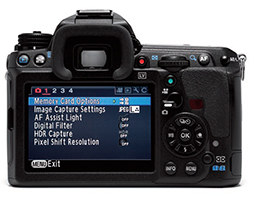

Performance
Our tests were conducted using the Pentax-DA 16-85mm f/3.5-5.6 ED DC WR zoom lens (equivalent to 24- 127mm in the 35mm format). The main camera settings for the tests were as follows:
• Lens Corrections: Corrections for Distortion, Peripheral illumination, Lateral CA adjustment, and Diffraction were set to ‘On’.
• Dynamic Range settings: Highlight and Shadow corrections were set to ‘Auto’.
• ISO Noise Reduction: Set to ‘On’ at ‘medium’ setting.
• Slow shutter speed Noise Reduction: Set to ‘Off ‘.
• Anti-aliasing filter simulator: Set to ‘Off ‘.
• Shake Reduction: ‘On’ for hand-held shots; ‘Off for shots using a tripod.
Overall, the Pentax K-3 II offered acceptably sharp images with pleasing colours and good Dynamic Range. Autofocus was fast in good light but was a bit slower in low lighting conditions.
Darkening of corners:
Control over darkening of corners was excellent. In our studio tests, at 16mm (the widest focal length), there was just a tinge of darkening in the lower corners; in actual outdoor shooting, you are not likely to notice any corner darkeng at any aperture! That is indeed a very good performance.
Distortion:
There was very slight barrel distortion at 16 and 24mm, indicating good lens design as well as in-built lens corrections.
ISO Noise:
At 25% screen size, control over digital noise was perfect up to ISO 3200, with very slight noise (you had to look for it) at ISO 6400, and a very slight softening of the image due to Noise Reduction.
ISO 51,200 as well as ISO 25,600 were visually noisy.
At 50% screen size, noise control up to ISO 1600 was very good, though in an emergency, I would use up to ISO 6400.
At 100% screen size, control over digital noise was good up to ISO 800, with a very slight softening of the image at ISO 800. Though in an emergency, I would use up to ISO 1600.
Sharpness:
Throughout the focal range, centre sharpness was better than corner sharpness. Overall, f/8 was the sweet spot and we felt that the best sharpness and contrast was at the 35/50mm settings. We also noticed that the Diffraction Control played its part in improving sharpness at the narrowest apertures, except at 85mm where images were soft at f/22, f/32 and f/40 at the center as well as the corners. At the 16mm setting, f/3.5 and f/4 were soft at the centre as well as corners.
Pixel Shift Resolution:
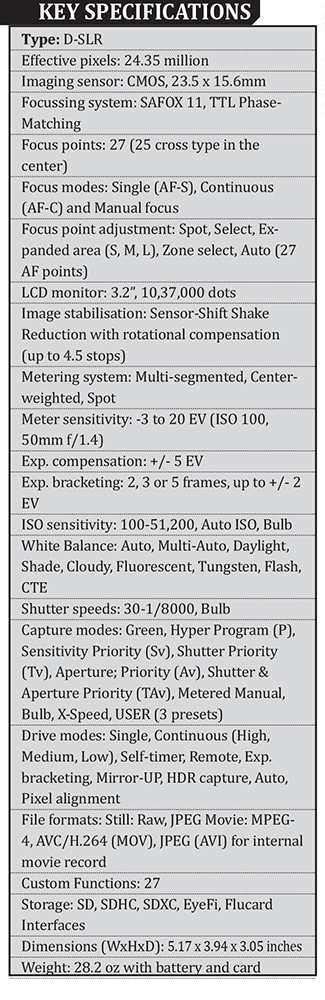
As mentioned in Key Features, Pixel Shift Resolution provides pictures with greater details. While this definitely works as indicated, you have to look closely to see the differences between a picture shot with and without this feature. Please note that the file size does not increase with this feature (as it does with say, the Olympus E-M5 Mark II) but the details definitely do.
Since the K-3 II does not have an Anti- Aliasing Filter, won’t we have ‘moire’ when photographing subjects with fine repeating patterns? For those instances where this could be a problem, the K-3 II has a solution in the form of an Anti- Aliasing Filter Simulator. When using it, the shake reduction system moves to simulate the effect of the AA filter, thereby mitigating the moire.
Video:
The Pentax K-3 II records video at up to 1080i/60 or 1080i/50 in QuickTime or 1080p at 30/25/24fps. 720p capture is also available. While not bad, we have seen better video quality from the competition.
Value for Money
The Pentax K-3 II (body) is available at an MRP of Rs.90,557 whereas the Pentax-DA 16-85mm f/3.5-5.6 ED DC WR zoom lens costs Rs.44,000. At this price and performance, it is in line with the competing D-SLRs. |SP
FINAL SCORE 82.5%
Design and Build Quality 18/20
Key Features 17/20
Ergonomics 18/20
Performance
Autofocus 4/5
Metering 3.5/5
Noise Control 3.5/5
Sharpness 3.5/5
LCD/VF 4/5
Auto WB 4/5
Sub-Total 22.5/30
Value for Money 7/10
PLUS
• Built-in image stabilisation
• Two SD card slots
• In-built lens corrections work very well
MINUS
• No in-built flash
•AF sensors mainly available in the center of the frame
• No Wi-Fi – Video quality could have been better
VERDICT
A multi-featured, well-designed D-SLR for enthusiasts. Best Buy!
Rohinton Mehta