

Flat-field lenses
Sorry if this has been asked before but I am a newcomer to photography. I have just started to pursue wedding photography. What are flat-field lenses and how do they differ from ‘normal’ lenses? Is there any advantage of one over the other? Please explain in very simple terms because I am not technically minded.
S. R. Sardesai, Amravati
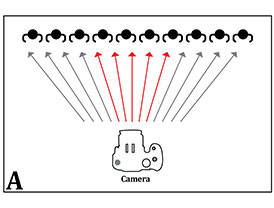
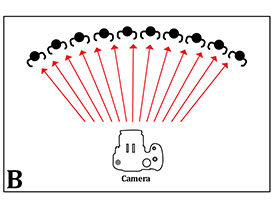
Since you are starting with wedding photography, I’ll try to explain using an example of what you could face during a group photograph. Have a look at the two situations, A and B.
In situation A, the people in the group are standing in a straight line, perpendicular to the axis of the lens. In B, the same group is standing in a curve. If you were to photograph these two situations, using a non-flat-field lens at wide open aperture and from a reasonably close distance, you might find that the people at the extreme ends in situation A are not as sharp as those in the centre. But with B, you may find that all the persons appear equally sharp. In situation B, all the persons are equidistant from the lens but in A, those standing at the sides are further away from the lens as compared to those in the centre. This is what happens when you use a non-flat-field lens (the type of lens we use for day-to-day photography.
Lenses designed for extreme closeup work (macro lenses) are ‘flatfield’ lenses since you need the entire subject sharp, from edge to edge.
You might ask as to why I mentioned earlier using the lens wide open and from a reasonably close distance? If you were to use the non-flat-field lens at a stopped down aperture (f/8 for example), and from a further distance, chances are that due to the depth of field, the persons standing at the sides could also appear reasonably sharp.
So to come to your query whether there is an advantage of one over the other, the answer is ‘yes’. In extreme close-up work (macro photography), a flat-field lens is definitely the better choice. In day-to-day work, with subjects that are far away from the lens, it really does not matter.
 Food Photography
I am an avid reader of Smart Photography magazine. Especially I like the tips you give in each issue. I want to be a food photographer. Could you please give some advice on food photography? How to take crispy clear photos of food and make the items more vibrant? Kindly discuss about the aperture, shutter speed, ISO as well as the postprocessing.
Prabhat Biswas, Pune
I could certainly advice you on food photography if you have specific queries but as it is, your query is too broad to be answered meaningfully in this column. Even then, here are some general tips.
When photographing food, you need to consider:
Arrangement: This includes how the food is laid out along with props (spoons, forks, knives, napkins, glasses, etc). It’s best to take help from a food-stylist.
Freshness of the food: Food should be prepared fresh; stale food will not look appetising.
Use of proper lenses, including the shooting angle: This is important too as the wrong lens (in terms of focal length) and improper working distance could distort the elements/ create a false perspective. Having said that, I have seen amazing food-shots using wide-angle lenses too.
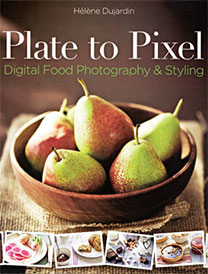
Lighting: This probably is the most important – make or break – aspect of food photography. Here, light modifiers (studio-umbrellas, soft boxes, reflectors etc) can provide different qualities to your lighting.A book on food photography that I can highly recommend is “From Plate to Pixel” by Helene Dujardin which was reviewed by Smart Photography in the April 2012 issue. You may also join a photography school where they teach about food photography.